
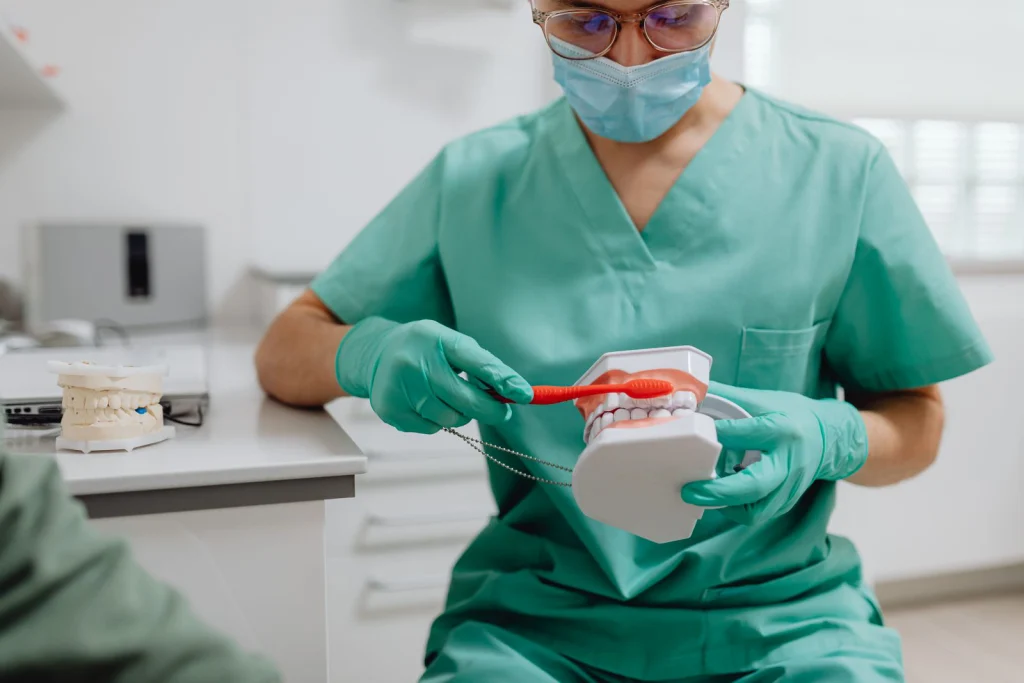
You can prevent most gum disease with two things working together: a gentle, thorough cleaning routine at home every day, and professional cleanings and gum checks that reach what home care can’t. Plaque is where gum disease starts, so the goal is simple even if the habit takes effort: don’t let plaque sit along your gumline long enough to harden into tartar and inflame your gums.
Try this: run your tongue along the inside of your lower front teeth. If you feel a rough ridge at the gumline, that is probably tartar, and it is exactly where gum problems often begin. This guide covers how gum disease develops, the daily habits that help prevent it, the risk factors worth knowing about, and how the Timonium office of Dr. Steven W. Haywood, DDS helps patients keep their gums healthy for the long run.
How gum disease starts
Gum disease is an infection of the tissues that hold your teeth in place. It rarely starts with pain, which is why it is so easy to miss.
Plaque, then tartar
Plaque is the soft, sticky film of bacteria that forms on teeth every day. Brushing and cleaning between your teeth remove most of it. The plaque that stays behind, usually along the gumline and between teeth, can harden into tartar, also called calculus. Once it has hardened, a toothbrush can’t remove it. It takes professional instruments.
Inflamed gums and pockets
The bacteria in plaque and tartar irritate the gums, which become red, swollen and quick to bleed. Left untreated, the gums can start to pull away from the teeth, leaving small spaces called pockets. Pockets collect more plaque and are harder to clean, so the infection can move deeper into the tissue and bone supporting the teeth.
From gingivitis to periodontitis
The early stage, gingivitis, affects the gums. The later stage, periodontitis, affects the structures underneath. Gum disease worsens as it progresses through its stages, and periodontal disease is the leading cause of tooth loss in adults. The encouraging part is that treatment can control and even reverse the early stages, which is why prevention and early care matter so much.
Daily habits that help prevent gum disease
There is nothing exotic about good oral hygiene. What makes it work is doing it well and doing it every day.
Brush gently, twice a day
Brush in the morning and before bed for about two minutes with a soft-bristled toothbrush. Aim the bristles toward the gumline, where plaque collects, and use small, gentle strokes. Scrubbing harder does not clean better, and it can wear enamel and push gums back. See why smart brushing beats aggressive brushing.
Clean between your teeth every day
A toothbrush can’t reach the tight spaces between teeth, and that is where gum problems often start. Floss, floss picks, interdental brushes and water flossers all have a place, and the best tool is the one you will use properly every day. Compare the options in floss picks vs. regular floss and why a water flosser might be a good idea.
Don’t avoid the spots that bleed
If your gums bleed when you brush or floss, it is tempting to leave that area alone. Gentle, consistent cleaning is usually the better response, because leaving plaque in place keeps the inflammation going. If bleeding doesn’t settle with better home care, have your gums checked. Read more about bleeding gums after a cleaning.
Think about what you eat and drink
Dr. Haywood asks patients about their diet, medications and habits, from sugar and acidic foods to tobacco and alcohol, because each one affects oral and overall health. Frequent sugary snacks feed the bacteria in plaque, so cutting back on sugar between meals is a simple way to give your teeth and gums less to fight.
Avoid tobacco and vaping
Smoking is widely recognized as a major risk factor for gum disease, and it can also hide one of the early warning signs, since a smoker’s gums may bleed less even when they are inflamed. Vaping is often assumed to be gentler, but nicotine still reaches the gums. Read how smoking and vaping affect your teeth and gums.
Risk factors worth knowing about
Some people are more prone to gum disease even with good habits. It helps to know whether any of these apply to you, and to mention them at your visit:
- Smoking or vaping, as above
- Diabetes and other health conditions. The health of your gums has been linked to serious health risks such as diabetes and cardiac disease.
- Hormonal changes, such as during pregnancy, which can make gums more prone to inflammation
- Medications, including those that cause dry mouth. Tell the office about every prescription and over-the-counter medication you take.
- Family history, since some people seem more susceptible than others
- Hard-to-clean teeth and dental work, such as crowded teeth, bridges and implants, which need extra attention
Why professional care is part of prevention
Even the most careful home routine leaves some plaque behind, and tartar can only be removed with professional instruments. Professional care also finds problems you can’t see or feel yet.
A full hour for your cleaning
The practice recommends a professional cleaning every six months, and cleaning appointments here last a full 60 minutes. That time lets the hygienist remove plaque and tartar thoroughly, including below the gumline, and check the health of your gums rather than rushing. The practice holds very high standards for gum health and strives for zero bleeding and zero infection.
Measuring your gums
The practice’s experienced hygienists take the lead on gum health, identifying, explaining, treating and monitoring everything from small, isolated areas of gum disease to the most severe cases. Careful gum measurements show whether pockets are forming, often before you notice anything. For more on what a visit covers, see do I need a dental cleaning if I brush and floss?
Knowing which bacteria are present
Oral DNA testing can identify which of the 11 most suspected periodontal pathogens are present. Knowing exactly what is there helps the practice diagnose gum disease and personalize treatment rather than treating every case the same way.
If prevention isn’t enough
If your gums already show signs of infection, the next step is treatment, not just a better toothbrush. At Dr. Haywood’s practice, 98 percent of periodontal therapy is non-surgical and comfortable. Depending on your needs, care can include scaling and root planing, a deep cleaning that removes harmful bacteria from beneath the gums, along with anti-microbial irrigation, site-specific antibiotics such as Arestin or Atridox, and laser therapy. When you are diagnosed, Dr. Haywood meets with you to develop your individual treatment plan.
For patients who prefer a holistic approach, laser and ozone therapy clear bacteria and infection from the gums without chemicals, which tends to mean faster healing. Learn more about gum disease treatment in Timonium and holistic dentistry, or check the warning signs of gum disease.
Keeping treated gums healthy
Gum infection that is caught early and treated can be managed and controlled, but it is never completely cured. After a deep cleaning, you may be put on follow-up care every 3 to 4 months. Regular follow-up creates an environment for the gums and bone to heal and helps prevent further damage, and skipping it can let the gum condition return.
Paying for preventive and gum care
The practice is out of network with all dental insurance providers. You pay at the time of your visit, and the office files the claim on your behalf so your plan can reimburse you for whatever it covers. Health savings and flex plans are welcome, and financing is available through CareCredit, with no-interest options for up to 12 months, and Cherry, with plans from 3 to 24 months. See financing options.
Frequently asked questions
Can gum disease be prevented?
For many people, good daily home care combined with regular professional cleanings goes a long way. Some people are more susceptible because of health conditions, medications or habits, which is why regular gum checks matter even if you brush and floss well.
How often should I have my teeth cleaned to prevent gum disease?
A professional cleaning every six months is recommended. If you have been treated for gum disease or have dental implants, follow-up care every 3 to 4 months may be recommended instead.
Can I live a normal life with periodontal disease?
Periodontal disease can be managed and controlled with treatment and ongoing maintenance, though it is never completely cured. Keeping up with home care and follow-up visits is what keeps it in check, and caring for your gums also helps protect your overall health.
Is gum disease reversible?
Treatment can control and even reverse the early stages of gum disease. More advanced gum infection can be managed and controlled, which is why it pays to act early.
Protect your gums with a visit in Timonium
If you are due for a cleaning or want your gums checked, request an appointment or call (410) 453-9399. The office of Dr. Steven W. Haywood, DDS is at 108 W Timonium Rd, Ste 200, Timonium, MD 21093, serving Timonium, Towson, Pikesville, Baltimore and the surrounding communities. New patients are always welcome. Learn more about dental cleanings and preventive care.
Ready to see your future smile?
Due for a cleaning? Book a gum check in Timonium and keep gum disease from getting a foothold.