Is a perfect smile possible? If “perfect” means teeth that look like a retouched magazine photo, probably not, and most people wouldn’t want that look up close anyway. A natural, noticeably brighter and more balanced smile is realistic for many people, and teeth whitening is often where it starts. At the Timonium office of Dr. Steven W. Haywood, DDS, whitening is done in the office as laser power whitening, with a plan customized to your teeth. It can’t change everything, though, so it helps to know ahead of time what it can and can’t do.
This guide covers what realistic whitening results look like, where whitening stops working and other treatments take over, and how to see a likely result before you commit. For the step-by-step visit itself, read teeth whitening in Timonium: what to expect.
What people usually mean by a “perfect” smile
When patients describe the smile they want, they rarely ask for a specific shade number. They talk about teeth that don’t look yellow in photos, a chip that stops catching their eye, a gap that closes, or old dark fillings that disappear. In other words, “perfect” is usually shorthand for “nothing I notice anymore.”
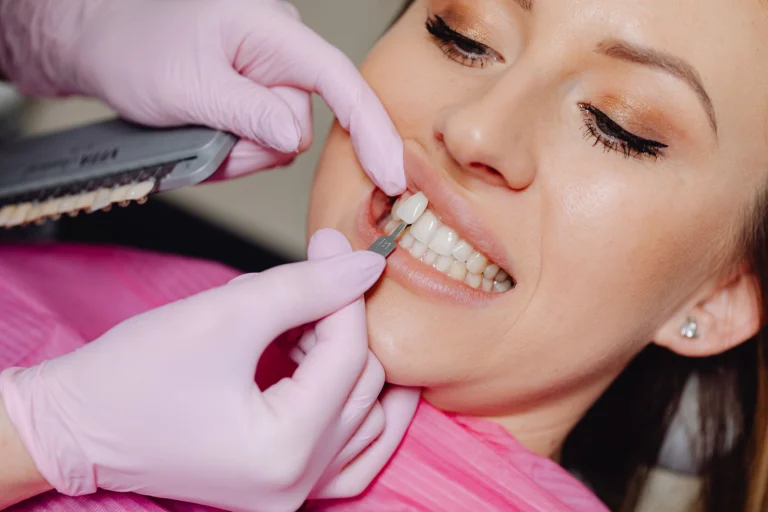
That is a helpful way to think about it, because it turns a vague goal into specific ones. It also explains why the brightest possible white isn’t always the best choice. Teeth that are much whiter than the whites of your eyes, or perfectly uniform with no natural translucency, can read as artificial. Dr. Haywood insists on a natural, never-fake look for cosmetic work, and that principle applies to whitening as much as to veneers.
What teeth whitening can realistically do
Professional whitening lightens natural tooth enamel. At the practice, a thirty-minute in-office whitening treatment is followed by a laser applied for 1 to 2 hours, which activates the hydrogen peroxide in the whitening agent so it works faster and more effectively, helping dissolve stains, including ones that like to hide. Learn more about laser whitening.
Stains that tend to respond well
Teeth that have gradually yellowed, or picked up surface stains from coffee, tea, red wine or tobacco, are usually the best match for whitening. After treatment, an instant lightening is seen in most cases, according to the practice’s post-whitening instructions.
Where whitening reaches its limits
- Dental work doesn’t lighten. Crowns, veneers, bonding and tooth-colored fillings keep their color while the natural teeth around them get brighter.
- Very dark teeth may only partly respond. If your teeth are very dark, Dr. Haywood will counsel you on your options before anything begins.
- One dark tooth needs a closer look. A single tooth that is darker than its neighbors should be examined before any cosmetic treatment.
- Color is all whitening changes. It won’t close a gap, repair a chip or straighten a tooth.
Results vary, and they fade without care
Everyone responds a little differently to whitening. The practice’s post-op instructions also point out that some rebound, a gradual drift back toward the original color, is not uncommon. That doesn’t mean whitening failed. It means a bright result needs looking after, which is covered in how to keep a whiter smile after tooth whitening.
When whitening alone isn’t enough
If the thing you would change about your smile isn’t only color, whitening may be one step in a plan rather than the whole plan. Teeth whitening is one of several cosmetic services at the practice, alongside the options below. See all of them on the cosmetic dentistry page.
Dental bonding
Dental bonding uses tooth-colored composite resin sculpted directly on the tooth to repair chips, fractures and discoloration, close gaps and change the shape of teeth. It can be done in a single visit and typically needs no anesthesia. Composite resin can stain over time, so it asks for a little extra care after coffee, tea, cola or red wine.
Porcelain veneers
Porcelain veneers are thin, translucent shells bonded to the front of the teeth to correct stains, chips, gaps and crooked teeth. Porcelain resists stains better than natural teeth or composite. A veneer can make a tooth look much better, but it is not a fix for decay: an unhealthy tooth is treated first. Where a tooth underneath is very dark, a veneer may need to be thicker or more opaque in those areas.
Tooth-colored fillings in place of dark metal
Old silver fillings can make teeth look gray or older than they are. As a mercury-free practice, Dr. Haywood never uses amalgam, and old metal fillings can be replaced with tooth-colored composite matched to your teeth, following safe removal protocols. Read about mercury-free dentistry.
Crowns
For a tooth that is extensively damaged, a porcelain dental crown restores its shape and protects it, and is made to replicate the color and translucence of natural teeth. When a more conservative repair will do the job, that comes first.
Why candidacy matters more than promises
Be cautious of anyone who guarantees a dramatic result for every person who wants whiter teeth. Whether whitening is a good idea for you depends on things only an exam can show: the kind of staining you have, the health of your teeth and gums, and how much visible dental work is on your front teeth.
That is why every whitening plan at the practice starts with a consultation. Dr. Haywood looks at your current shade and the type of discoloration, talks through what you want, and tells you honestly if another option would serve you better. For some people that conversation confirms whitening is the right move. For others it shows that bonding a chip or replacing one old crown would make the bigger difference. If you want the safety side of that conversation, read tooth whitening safety and your dentist.
How to see a likely result before you commit
You don’t have to imagine the outcome. A few tools at the practice take much of the guesswork out of cosmetic decisions:
- Cosmetic imaging. Digital photos of your smile are changed on the imaging computer, so you can see a before-and-after preview. It is part of every cosmetic evaluation. Learn about cosmetic imaging.
- A “test drive” for veneers. If veneers are part of your plan, you evaluate a trial set before the final set is made.
- Real patient photos. The smile gallery shows before-and-after photos of actual patients of Dr. Haywood.
Setting realistic goals for your own smile
Before your consultation, it helps to jot down answers to a few questions:
- What, specifically, do you notice first when you look at your smile?
- Do you want a subtle refresh or a clearly visible change?
- Do you have crowns, veneers, bonding or fillings on the teeth that show when you smile?
- Is there an event or date you are working toward?
- How much upkeep are you comfortable with afterward?
Bringing these answers keeps the conversation focused on your smile rather than a generic ideal. If you would like a structured way to look at your teeth first, try the smile self-check.
Why patients choose Dr. Haywood for cosmetic work
Dr. Steven W. Haywood, DDS has more than 35 years of experience, cosmetic training from New York University’s Aesthetic Continuum and membership in the American Academy of Cosmetic Dentistry. The practice holds a 4.7-star Google rating from 147 reviews (checked September 7, 2026), and patients come to the Timonium office from Towson, Hunt Valley, Baltimore and nearby communities.
What whitening and cosmetic treatment cost
Your fee depends on your plan, so it is discussed at your consultation. The practice is out of network with all dental insurance providers: you pay at the time of your visit, and the office files the claim so your plan can reimburse you for whatever it covers. Many plans treat whitening as cosmetic, so check your benefits. HSA and flex plans are welcome for eligible care, and financing is available through CareCredit, with no-interest options up to 12 months, and Cherry, with plans from 3 to 24 months. See financing options.
Frequently asked questions
Can whitening give me perfectly white teeth?
Whitening can make natural teeth noticeably brighter, but how white they get depends on your teeth and your type of staining. The goal at the practice is a bright result that still looks natural, and your consultation will tell you what is realistic.
Why won’t my crown or veneer match after whitening?
Crowns, veneers, bonding and fillings don’t change color when you whiten. If one is on a front tooth, it may need to be replaced after whitening so it matches your new shade. Read more about whitening with crowns, veneers or bonding.
Can veneers give me a flawless smile?
Veneers can correct stains, chips, gaps and crooked-looking teeth, and Dr. Haywood designs them to look natural rather than fake. They can’t fix decay, so any health problems are treated first, and you try a test-drive set before the final veneers are made.
How do I know if I’m a good candidate for whitening?
An exam and a conversation about your goals are the only reliable way to know. People with healthy teeth and gums whose teeth have yellowed or picked up surface stains tend to be the best candidates.
Talk about a realistic smile goal in Timonium
Want to know what is possible for your smile? Request an appointment or call (410) 453-9399 to schedule a consultation with Dr. Haywood. The office is at 108 W Timonium Rd, Ste 200, Timonium, MD 21093. You can also read more about teeth whitening.
Ready to see your future smile?
Book a consultation in Timonium to find out what is realistic for your smile.