If you have been searching for a straight answer on how much dental implants cost, you have probably come away frustrated. Most dental websites, ours included, do not post a flat price for a tooth implant. That is not evasion. An honest fee depends on details only an exam and a 3D scan can show, and a number quoted before then is usually wrong in one direction or the other.
This guide explains what actually drives implant costs at the Timonium office of Dr. Steven W. Haywood, DDS, what the published full-mouth range looks like in the Baltimore and Timonium area, how dental insurance and financing options work here, and what happens at the consultation where your own fee is set.
Why there is no honest flat price for dental implants
Two things make a single number misleading.
You may need fewer implants than missing teeth
Replacing several missing teeth does not automatically mean one implant for each tooth. An implant-supported bridge uses two or more implants to hold three or more teeth joined together, and a full arch of teeth is built on a foundation of at least four implants. A price per missing tooth would overstate what many cases actually need.
Implants are not always the right answer
Dental implants are the strongest long-term way to replace missing teeth for many people, but a consultation sometimes shows that another option suits your mouth, your health or your budget better, such as a fixed bridge or a removable partial denture. It is worth finding out which treatment is right for you before pricing anything.
What affects dental implant costs
Once a treatment plan is set, implant costs vary based on a handful of factors. Simple cases cost less, and complex cases cost more.
- How many implants you need. One implant post for a single damaged or missing tooth, several for an implant-supported bridge, or four or more for a full arch.
- What the implants hold. A single crown, a bridge, snap-on implant teeth or a fixed full-arch set each carry a different fee.
- Bone grafting. Bone loss after a tooth extraction, or after a tooth has been missing for years, can leave the bone too thin. Grafting can often build it back up, but it adds a step and a cost. The 3D scan shows whether you need it at that same visit.
- Tooth extraction. If a damaged tooth has to come out first, the implant can sometimes be placed at the time of the extraction.
- Guided surgery. A 3D-printed surgical guide matters most when bone is limited or several implants must line up. Not every implant needs one. Read about computer-guided implant surgery.
- Materials. Titanium or ceramic implants, and the materials chosen for the teeth themselves.
Single tooth, implant bridge or full arch: how the options compare
A single tooth implant
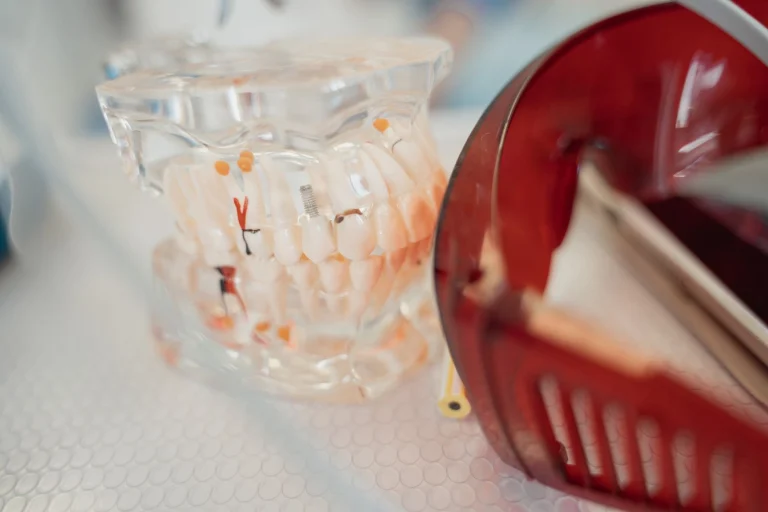
A single implant replaces the root and the crown of a missing tooth without affecting the natural teeth beside it. It has three parts: the implant post that replaces the root, the abutment that supports the new tooth, and the crown. In this office, a single tooth implant is regularly less expensive and more conservative than a traditional bridge, which has to be attached to the neighboring teeth. Leaving a back tooth unrestored while the implant heals can also reduce the overall expense.
An implant-supported bridge
When several teeth are missing in one area, two or more implants can support three or more teeth joined together. That saves the cost of the extra implants and the post on each one, so an implant bridge can cost 20–30% less than placing an implant for every missing tooth. The trade-off is cleaning: you will need a floss threader, because food can collect under dental bridges.
Snap-on implant teeth
Removable teeth that snap onto implants cost less than fixed full-arch teeth. The upper set usually sits on four or five implants and the lower set on at least two, and more implants can often be added later when finances allow. A full upper set of snap-on implant teeth costs roughly 30% less than a comparable fixed set.
Fixed full-arch teeth
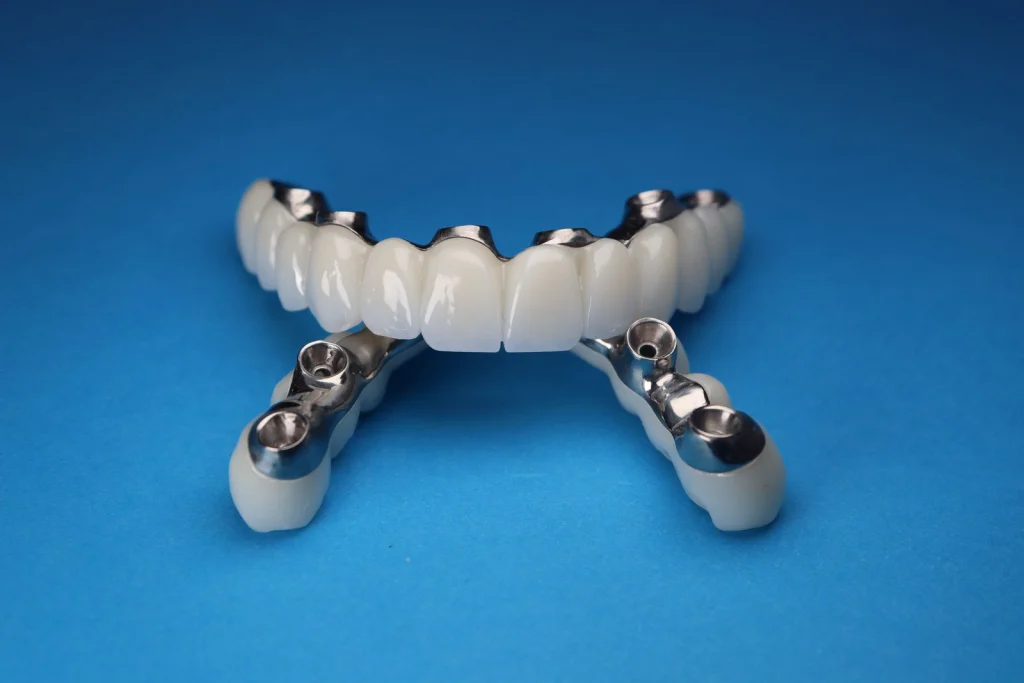
A complete set of teeth screwed or cemented onto at least four implants, sometimes called All-on-4, chews the most like natural teeth and is the most costly option. In the Baltimore and Timonium area, full mouth implant treatment typically ranges from $20,000 to $50,000 or more per arch, depending on the number of implants, the type of prosthetic and any preparatory procedures. See fixed full-arch implant teeth.
Titanium or ceramic implants
Titanium implants are the most common and successful type: titanium is biocompatible and fuses well with bone. Ceramic and zirconia implants are also available and are essentially the holistic implant of choice for patients who want to avoid metal, though ceramic implants cost more than titanium. Implants also come in specific lengths and widths, sized for your particular need.
If a metal-free mouth matters to you, raise it at your consultation. Dr. Haywood can explain which implant suits your mouth and your priorities, and holistic dentistry at the practice includes testing dental materials for biocompatibility before they are used.
Why an average cost online can mislead
National figures for the average cost of a tooth implant mix together very different cases: a single implant in healthy bone, a case that needs extractions and bone grafting first, and a full mouth of fixed teeth. None of them tells you what your own treatment will cost.
Implants can cost a little more up front than other ways of replacing missing teeth, but they are built to last. Current thinking is that implants may last a lifetime: they don’t decay, and they seem far less affected by gum disease than natural teeth, as long as they are cleaned and checked regularly.
Does dental insurance cover implants?
The practice is out of network with all dental insurance providers. You pay at the time of your visit, and the office files the claim on your behalf so your plan can reimburse you for whatever it covers. How much insurance will cover for implants depends entirely on your own plan, so it is worth checking your benefits before treatment. Health savings and flex plans are welcome.
Financing options for dental implants
Financing is available through CareCredit, which offers no-interest options for up to 12 months, and Cherry, with payment plans from 3 to 24 months. Both offer quick online pre-approval, so you can come to your consultation knowing your payment options. Final terms are set by each provider and are subject to approval. Compare financing options.
What happens at your implant consultation
- Exam and health history. Dr. Haywood examines your mouth, reviews your health history and talks through your goals. Active gum disease is treated before implants.
- A 3D scan. A cone beam CT scan shows the quality and quantity of your bone and whether grafting is needed. The practice uses a low-dose Green CT scanner.
- Your plan and your fee. You leave with a treatment plan for your own case, the options that suit it, and what each one costs.
A single tooth can be restored in as little as 6–8 weeks after implant surgery, and the whole process from first visit to finished tooth can take several months. If another office has already given you an implant plan, second opinions are always complimentary.
Why experience matters for implants
Dr. Steven W. Haywood, DDS has practiced cosmetic, restorative and implant dentistry in Timonium for over three decades. Dr. Haywood graduated with distinction from the University of Detroit dental school in 1987, completed the U.S. Air Force advanced residency program with internships including oral surgery, and is a Fellow of the International Congress of Oral Implantologists. Every phase of implant care, from the scan to the finished teeth, happens in one office.
Frequently asked questions about implant costs
How much does a single tooth implant cost?
It depends on your case. Complex cases cost more and simple ones less, ceramic implants cost more than titanium, and bone grafting or a tooth extraction adds to the total. Your own fee is set after your exam and scan.
Is an implant cheaper than a bridge?
In this office, a single implant is regularly less expensive and more conservative than a traditional bridge, and it leaves the neighboring teeth alone.
Can I start with fewer implants and add more later?
Often, yes. Many people choose a lower snap-on denture on two implants for financial reasons, and more implants can often be added later for extra stability.
How long does implant treatment take?
A single tooth can be restored as little as 6–8 weeks after surgery, and the whole process can take several months, longer if grafting is needed first.
Book an implant consultation in Timonium
If you are missing one or more teeth and want an honest answer about what dental implants would involve and cost for you, request an appointment or call (410) 453-9399. The office is at 108 W Timonium Rd, Ste 200, Timonium, MD 21093, and patients come for implants from Timonium, Towson, Hunt Valley, Baltimore and Shrewsbury, PA. Learn more about dental implants in Timonium.
Ready to see your future smile?
Book an implant consultation in Timonium to get a fee for your own case.