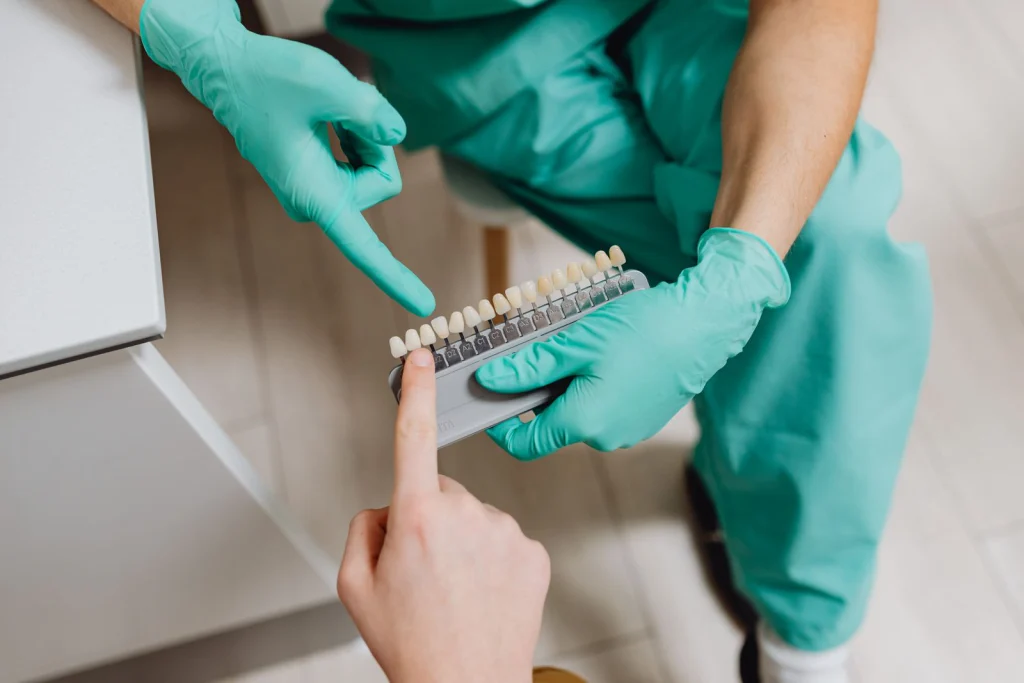
How much do you really know about cosmetic dentistry? Whitening, bonding, veneers and gum lifts are familiar words, but the details behind them are often misunderstood: what whitening can and can’t change, how thin a veneer can be, or what actually causes a gummy smile. This quiz tests your cosmetic dentistry IQ with twelve questions, and every answer explains how the treatment works at the Timonium office of Dr. Steven W. Haywood, DDS.
Keep track of your answers as you go, then check your score at the end. No peeking at the answers first.
How to take the quiz
Each question has three choices. Pick the one you think is right before reading the answer under it. The questions are grouped by topic: whitening, bonding and veneers, gums and straightening, and planning your smile. If a question makes you curious, follow the link to learn more about that treatment.
Questions about teeth whitening
Question 1: What does the laser do in laser teeth whitening?
- A. It sands stains off the surface of the teeth
- B. It activates the whitening agent so it works faster and better
- C. It seals the teeth so they never stain again
Answer: B. In-office laser power whitening starts with a whitening treatment applied in the office. A laser then activates the hydrogen peroxide in the whitening agent, significantly increasing how quickly and effectively it dissolves stains, including the ones that like to hide. Nothing is sanded away, and no whitening makes teeth stain-proof. Learn more about laser whitening.
Question 2: Will whitening lighten an existing crown or veneer?
- A. Yes, porcelain whitens just like enamel
- B. Only if the crown is new
- C. No, whitening works on natural teeth, not porcelain or composite
Answer: C. Whitening agents lighten natural tooth enamel. Porcelain crowns and veneers and composite bonding keep their original shade. That is why, when a plan includes whitening and new tooth-colored work, teeth are usually whitened first and the new work is matched to the brighter shade. For more whitening myths, see tooth bleaching fact and fiction.
Question 3: Your teeth are very dark. What happens next?
- A. Whitening is simply repeated until they are white
- B. Dr. Haywood explains your options before you start
- C. Nothing can be done for very dark teeth
Answer: B. Every whitening plan is customized, and if your teeth are very dark, Dr. Haywood counsels you on your options first so you know what to expect. When whitening alone isn’t the right fit, porcelain veneers and dental bonding can also correct discolored teeth. Read about teeth whitening in Timonium.
Questions about bonding and veneers
Question 4: What is another name for dental bonding done directly on the tooth?
- A. A direct veneer
- B. A partial crown
- C. A tooth sealant
Answer: A. Bonding applies tooth-colored composite resin to the tooth, where it is sculpted, trimmed and polished. Because it is completed directly on the tooth, it is also called a direct veneer. It can repair chips and discoloration, close gaps and change the shape of teeth, often in a single visit and typically with no anesthesia. See dental bonding.
Question 5: Which material resists stains better?
- A. Composite resin
- B. Porcelain
- C. They stain the same
Answer: B. Porcelain veneers resist stains better than natural teeth or composite. Composite bonding can pick up stains, so it helps to brush or at least rinse with water after cola, coffee, tea or red wine. Bonding still has its place: it is one of the most affordable cosmetic procedures and often the most conservative option. For a closer comparison, read three types of veneer materials compared.
Question 6: How thin can a porcelain veneer be?
- A. As thin as a contact lens
- B. About as thick as a crown
- C. Veneers are always thick enough to cover the whole tooth
Answer: A. A veneer can be as thin as a contact lens. It partially wraps around the tooth like a suit of armor, protecting and strengthening it, and unlike traditional veneers or crowns it does not require grinding down the entire tooth. Ultra-thin porcelain stays translucent and shiny like natural enamel. Learn about dental veneers.
Question 7: What do prepless veneers preserve?
- A. Your old fillings
- B. Most, if not all, of your natural enamel
- C. The original color of your teeth
Answer: B. Prepless, or minimal-preparation, veneers need little or no drilling and keep most if not all of your natural enamel. They can close gaps, brighten teeth without whitening and make teeth look straighter without braces. Not everyone qualifies: teeth with damage or older dental work often need traditional veneers. See prepless veneers.
Question 8: What is a “test drive” set of veneers?
- A. A trial set you evaluate before the final veneers are made
- B. A temporary set worn while teeth are whitened
- C. A discount set for first-time patients
Answer: A. Before your final veneers are made, you receive a trial set to evaluate. It confirms that the shape, color and look meet your expectations and that the result looks natural, never fake. The final porcelain is then hand-crafted in the USA by master ceramists.
Questions about gums and straightening
Question 9: What usually causes a gummy smile?
- A. Teeth that are too short
- B. Excess gum tissue covering normal-sized teeth
- C. Brushing too hard
Answer: B. A gummy smile is often caused by excessive gum tissue rather than short teeth. A gum lift moves the gum line upward on the upper teeth for ideal proportions, using a dental laser or radiosurgery. For bigger changes, the Haywood surgical smile makeover combines gum surgery with same-day custom veneers. Read gum contouring in cosmetic dentistry.
Question 10: Can crooked teeth look straighter without braces?
- A. No, braces are the only option
- B. Yes, but only with aligners
- C. Often, with veneers, bonding, crowns or tooth and gum reshaping
Answer: C. Instant orthodontics uses porcelain veneers, bonding, crowns and tooth and gum reshaping to transform crooked, gapped or discolored teeth in as little as one or two visits. When teeth genuinely need to move first, Invisalign clear aligners can shift them into position before a veneer makeover begins. Explore orthodontic options.
Questions about planning your smile
Question 11: Can you see your new smile before treatment starts?
- A. No, you see the result only at the end
- B. Yes, with cosmetic imaging
- C. Only by looking at other patients’ photos
Answer: B. Before-and-after imaging is part of every cosmetic evaluation. Digital photographs of your smile are changed on the imaging computer, so you and Dr. Haywood can plan the improvements together before you commit. You can also compare real results in the smile gallery. See how cosmetic imaging works.
Question 12: How quickly can a smile makeover be done?
- A. It always takes many months
- B. In as few as two visits, or in a single day for a deadline
- C. Only one tooth can be treated per visit
Answer: B. An ultimate smile makeover combines treatments in a customized plan that can be completed in as little as two visits. If you have a wedding or another deadline, a same-day smile makeover brings treatment into a single day. Plans that include implants or tooth movement take longer.
How did you score?
Count your correct answers.
- Ten to twelve right: Cosmetic dentistry expert. You know what each treatment can and can’t do, which makes planning a makeover much easier.
- Six to nine right: Well informed. A few details surprised you, which is exactly what a consultation is for.
- Five or fewer: Curious beginner. That is completely normal, and there is no quiz at your appointment, only a conversation about your goals.
Whatever your score, the most useful answer is the one about your own smile. Bring your questions to a consultation, and see every option on the cosmetic dentistry in Timonium page.
Frequently asked questions
Is cosmetic dentistry only about appearance?
Not always. Bonding can repair chips and fractures, veneers can strengthen chipped teeth, and a crown can protect a damaged tooth while improving its look. Many cosmetic treatments restore as well as beautify.
Which cosmetic treatment is the most conservative?
It depends on the problem, but direct bonded veneers are often the most conservative option, and prepless veneers preserve most if not all of your natural enamel when you qualify.
Does insurance cover cosmetic dentistry?
Coverage depends on your plan, and many plans limit purely cosmetic treatment. The practice is out of network with insurance companies: you pay at the time of your visit, and the office files the claim on your behalf so your plan can reimburse you for anything it covers. HSA and flex plans are welcome, and financing is available through CareCredit, with no-interest options for up to 12 months, and Cherry, with plans from 3 to 24 months.
Is cosmetic treatment uncomfortable?
Many cosmetic treatments are gentle; bonding, for example, typically needs no anesthesia. The practice keeps you comfortable throughout, laughing gas is complimentary, and oral and IV sedation are available if you are anxious.
Put your cosmetic dentistry knowledge to use
Now that you know the basics, find out which treatments suit your smile. Request an appointment or call (410) 453-9399. The office of Dr. Steven W. Haywood, DDS is at 108 W Timonium Rd, Ste 200, Timonium, MD 21093, serving Timonium, Towson, Pikesville and Baltimore. Enjoyed the quiz? Try the dental emergency quiz next.
Ready to see your future smile?
Scored well? Now find out which treatment suits your smile.